


Strip 2028 - Click strip above to goto the next strip.
First Seen: Mon 2019-12-02
Story & Art: Scott Bieser - Sci-Fi Adventure Monday & Thursday.
Dark plans fall like thunderbolts.


Quantum Vibe
A thousand years in the future, humanity has colonized worlds in nearly 100 galaxies, thanks to Quantum Vibremonic technologies developed five centuries earlier. Other new technologies have created various off-shoots of humanity and extended life expectancies five-fold. The story begins with how a mad scientist and his plucky assistant, along with their robot friend, brought humanity to the stars, and continues with the adventures of some unique people in fantastic places.


QV on a short break [ Jul 15, 2026 ]
QUANTUM VIVE is taking a break for a few weeks, as we prepare for Part 2 of the Novo Palermo story, and also for a Kickstarter campaign for Part 1, which will start in September.
In the meantime, Not-Safe.Space will continue, as a murder mystery begins and the relationship between Eithne and Diana develops in unexpected directions.
Not-Safe.Space is a NSFW strip but more than half the pages are SFW so I've set those to *not* require a Patreon membership. Readers should be able to follow the story without seeing the NSFW pages. If I've done this right.



Transcript For Strip 2028
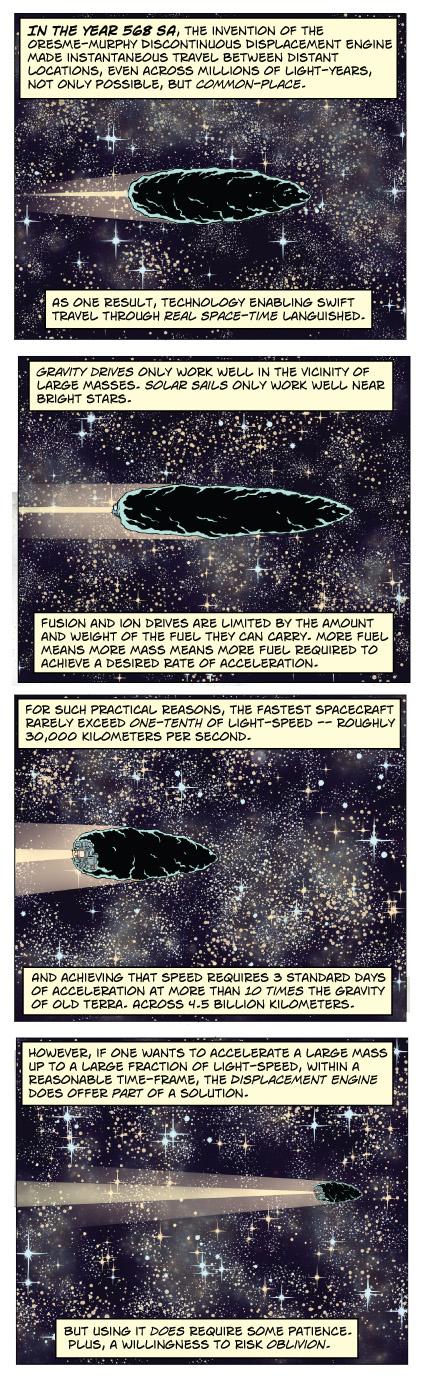
Panel 1A large, long, dark asteroid is barely visible against the stellar background. Some speed lines to indicate it's moving along its length, in ¾ aspect to foreground-right
Caption: In the year 568 SA, the invention of the Oresme-Murphy Discontinuous Displacement Engine made instantaneous travel between distant locations, even across millions of light-years, not only possible, but common-place.
Caption: As one result, technology enabling swift travel through real space-time languished.
Panel 2
The asteroid is now seen in side-view. We can see a bit of machinery on the back end of it.
Caption: Gravity drives only work well in the vicinity of large masses. Solar sails only work well near bright stars.
Caption: Fusion and ion drives are limited by the amount and weight of the fuel they can carry. More fuel means more mass means more fuel required to achieve a desired rate of acceleration.
Panel 3
The asteroid is now moving away.
Caption: For such practical reasons, the fastest spacecraft rarely exceed one-tenth of light-speed – roughly 30,000 kilometers per second.
Caption: And achieving that speed requires 3 Standard days of acceleration at more than 10 times the gravity of Old Terra. Across 4.5 billion kilometers.
Panel 4
The asteroid is farther away now.
Caption: However, if one wants to accelerate a large mass up to a large fraction of light-speed, within a reasonable time-frame, the Displacement Engine does offer part of a solution.
Caption: But using it does require some patience. Plus, a willingness to risk oblivion.
Web-comics Scott Reads
SPACETRAWLERGrrl Power
Schlock Mercenary
Unsounded
Girl Genius
XKCD
Drive
Day By Day
Saturday Morning Breakfast Cereal
Questionable Content
Gunnerkrigg Court
Something * Positive
Oglaf (NSFW)
Trekker
POWERNAP
Cassiopeia Quinn
Dresden Codak
Devil's Candy
For news and reviews:
Bleeding Cool
Comics Worth Reading
Framing Graphics © 2024 Big Head Press